August 7, 2026
We are undertaking a major revision of our data collection app to make it easier and more fun to track plant and animal seasonal activity! The new app will also feature new challenges, badges, social sharing, and will eventually be offered in Spanish as well as English.
Timeline
The first release of the app will focus on core observation functionality with a few new features. We will have subsequent releases of the app with additional features over the next couple of years.
We are getting very close to having all of the features for our first release in the development version of the app. Over the coming months, we will continue to release versions of the app to our group of beta testers to ensure that the new features are working as intended for various observers with different sites, species, Local Phenology Programs, etc.
After the features are well-tested, our next step will be testing the connection between the app and the various tools that we use to deliver Nature's Notebook data. This stage has the most uncertainly in terms of timeframe, as we may run into issues that will further delay release. For that reason, we no longer anticipate a September release of the app.
Rest assured that we will continue to work extremely hard to deliver the app as soon as possible.
Check back on this page for updates on the timeline. If you’d like to sign up to be a beta tester, please do so here.
What's changing?
The new Nature's Notebook app will have all the same core features as the current app for making observations.
We will be adding features that have long been requested by Nature's Notebook users, including:
Release 1:
- Phenophase photos that show the life cycle stage for a particular species (these will be available for most commonly observed species and campaign species in the initial release; the remainder to be added later)
- Precise locations of plants (adding latitude & longitude for individuals) and a map to view plant locations
- The ability to manage sites, plants, and animals in the app
- The ability to see previously submitted observations, including those collected by other members of a Local Phenology Program (This may need to be postponed to a later release but we're pushing to get this into Release 1. Updates will be posted here)
Later release:
- The ability to submit photos along with your observation (via an integration with iNaturalist)
Other key changes include:
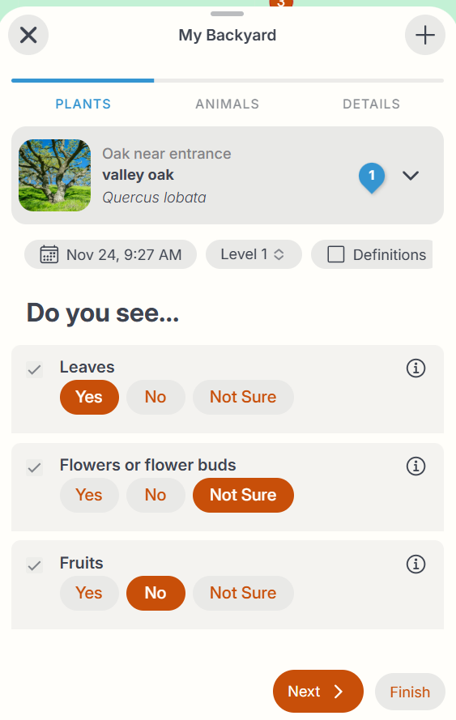
New Levels for protocols
- We are implementing a leveled approach to observing. This new feature will allow for an easier onboarding process for new observers, focusing on simple phenophases at first and then adding more complex phenophases and intensity questions later on.
- You will be able to select from three levels when making observations. For plants:
- Level 1 includes questions about only the simplest phenophases, typically Leaves, Flowers or flower buds, and Fruits. This is ideal for new observers or youth.
- Level 2 includes all phenophases. This is designed for observers who have experience, but may not want to answer intensity questions.
- Level 3 includes all phenophases and intensity questions (which matches the current Nature's Notebook app). This is ideal for experienced observers who want to answer all questions.
- For animals:
- Level 1 includes 1-3 of the simplest phenophases.
- Level 2 includes slightly more difficult phenophases and abundance question.
- Level 3 includes all phenophases and abundance question.
- You will have the option to choose a default Level, but you can change it whenever you want.
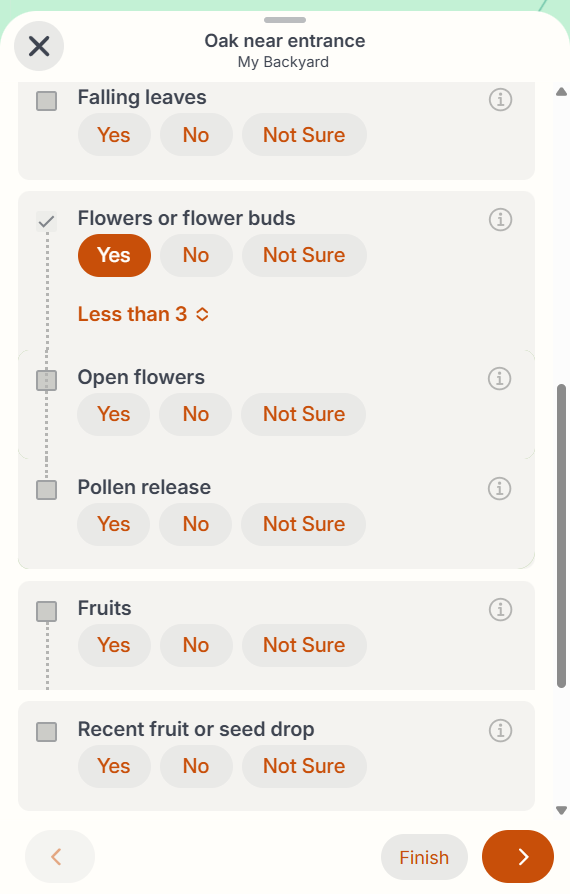
Nested phenophases
- For phenophases that are dependent on one another, you'll need to answer "yes" to the parent phenophase to answer "yes" for the child phenophase (example: You must answer "yes" for Flowers or flower buds before you can answer "yes" or "not sure" for Open flowers; A "no" response for Flowers for flower buds will result in an automatic "no" for open flowers)
- This will improve data quality and reduce the initial set of phenophase questions you need to answer
We will also make changes to reduce confusion and remove questions that place unnecessary burden on observers, including:
- Removing questions about snow cover and some questions about site characteristics
- Ensuring the online interface accessible via web browser matches the interface of the app
- Replacing the complete/incomplete status on the Review calendar with improved features to see your past observations
- Updating animal search methods to include distance for walking search, and area of the site only for observers using area search
Frequently Asked Questions
Will the old app be replaced, or will it still be available after the new app launches?
If you have the old app downloaded on your mobile device, you will still be able to use it on your device for a limited period of time. However, the old app will no longer be supported or updated, so if the app stops working due to mobile device updates or other reasons, you will not be able to use it.
Once we release the new app, the old app will prompt you to upgrade to the new app. You can decline the upgrade if you chose and continue to use the old app until it no longer works on your device.
Once we release the new app, the current online data entry interface on the Nature's Notebook website will be replaced with the web version of the new Nature's Notebook app. If you use paper datasheets, you'll still be able to access those by logging into your account on the Nature's Notebook website. You can enter your data via the web version of the new app on your computer.
Will the new app be supported on my old Android/iPhone device?
Yes, the new app will be supported on all mobile devices, as long as the device is running version 5.1 or later for Android, or 15 or later for iOS. Note that the version is not the same as the model of your phone. As of March 2026, the the latest version of Android is 15, the latest version of iOS is 26.4.
However, users running older software versions will still be able to use the app on a browser on their device.
What do the new levels mean for data quality? Will the data from these levels be treated differently in the database?
There will be a field in the database that indicates the level at which the observation was made. Our intention is that if observers are not confident about answering the full set of phenophases and intensity questions, they will use Levels 1 or 2. This will result in higher data quality across all observations.
We have also made some changes to the Nature's Notebook protocols as of March 2026, including a name change for the "increasing leaf size" phenophase and updates to protocols for conifers, mammals, reptiles, amphibians and fish. You can see a description of the changes here.
How will I be able to add locations for plants?
When registering a new plant, you’ll be able to enter the location (by using your current location if you are right next to the plant, or moving a pin on the map to the plant's location). We will have a way to walk you through adding locations for existing plants, including by using your phone’s location to place a pin for your plant’s location, or by manually entering coordinates for your plants.
If you do not wish to enter locations for individual plants, you can ignore this feature. Your plants will retain the location of your site, which is how the current app works. We will also have a feature to allow you to obscure the location of individual plants and sites.
When will the new app be available in Spanish?
We anticipate that the Spanish language version of the app will be available in the second or third release, likely in 2027-2028.
Should I wait for the new app release to do Nature’s Notebook trainings?
There are several variables that will impact the exact timing of the app release, including final updates, testing, and how long it takes the Apple and Google Play stores to approve and list the app. For that reason, you may wish to plan to use the current version of the app in your planned trainings.
Keep in mind that the core functionality of the app won’t change; your observers will still be answering the same basic yes/no questions about phenophases. Please see the above section on What’s Changing for the key changes coming to the app.
Will the new app be incorporated into the Observer Certification Course?
Yes, we will be updating the Observer Certification Course (hosted at learning.usanpn.org) to reflect the new app, with three new Certification Levels to match the Levels that observers will select in the app. See the table below for a description of how the content from the current Observer Certification Course will map to the new Certification Levels.
| Current Observer Certification Course | Where content is moving to in new Certification Courses (Anticipated April 2026) |
| Module 1 - How to Observe with Nature’s Notebook | Level 1:
|
| Module 2 - The Nature’s Notebook Mobile Application | |
| Module 3 - Plant and Animal Phenophases | Level 2:
|
| Module 4 - Intensity Measures | Level 3:
|
| Module 5 - Practice Making Observations | Incorporated into Level 2 |
If you have already completed the current Observer Certification Course, you will receive certification for all three Levels. However you may wish to review the content that will be new to you in Level 1 related to how to use the new Nature's Notebook app.
We will also provide support materials in the form of documents and videos to assist in explaining new features and how to carry out tasks in the new app. These support materials will be available on this page.
If you would like to take the Observer Certification Course before the launch of the new app, we suggest you only focus on the following modules:
Module 1: Lessons 1, 4, 7, 8, and 10
Module 2: Skip
Module 3: All Lessons
Module 4: All Lessons
Are the data added via the app vs website treated differently?
After the new app release, the data entry interface on the app and website will match. You may use whichever entry method works for you and your data will end up in the same place either way. We will still track whether the data were entered via a mobile app versus on the website and present that information to data users.
Do you have questions about the app? Email [email protected]
Give your input on new app features!
We are looking for a group of individuals who are willing to complete short surveys about the app as it is developed. Your input will help to shape the new app and ensure your preferences are considered!
This material is based upon work supported by the National Science Foundation under Grant No. 2404760.