In this Observer Story written by UCLA student Jennifer Yang, we learn about Nature's Notebook observers Rita Silverberg and Steve Amesbury, long time observers with the Pima County Master Gardeners Phenology Group in Tucson, Arizona. This story was part of UCLA Faculty Dana Cairns Watson's course "Science Writing for Public Engagement and Community Science Projects." Students interviewed Nature's Notebook observers and then wrote a creative piece to tell the observer's story.
Phenology can be found at any age. Whether it be someone in college, in the workforce, or in retirement, they can find the natural world a universal source of wonder. Rita Silverberg and Steve Amesbury show that discovering new passions, such as phenology, is possible at any stage of one’s life.

Rita and Steve’s path towards each other was gradual. Both graduated from the University of Arizona in the 1960s and shared the same social circles. While Rita ventured to California to work as a counselor and children and family therapist, Steve traveled to the University of Guam to work as a marine biology professor. Each of them developed their careers over the decades, only reconnecting when both moved back to Tucson, Arizona, “many, many, many, many, many years later.” Today, they live in Arizona, marking 22 years together as Life Partners.
Their journeys to phenology also took the scenic route. While Steve had a nature-heavy profession, having done fieldwork on Guam’s local reefs, studying fish species, he had never heard of phenology. He’s always had a long-standing interest in climate change and ecological science, so naturally, the subject piqued his interest. As he retired and moved back to Arizona, he grew his curiosity through taking courses at his alma mater, sharing what he learned with Rita as they tended their home garden. As he began sharing this interest with Rita, they both decided to join the Master Gardener Program in 2020, a program where volunteers learn and hold outreach projects to teach the community about gardening. At the time, a new phenology committee formed, training volunteers to make weekly observations of the plants scattered throughout the area’s three trails. Rita and Steve were two of the first phenology trainees in the program. Today, Rita and Steve are co-chairs of the Master Gardener Phenology Committee, with approximately 20 volunteer members. As co-chairs, they have also helped new community members, most of whom are also “retired academic folk,” realize new passions.

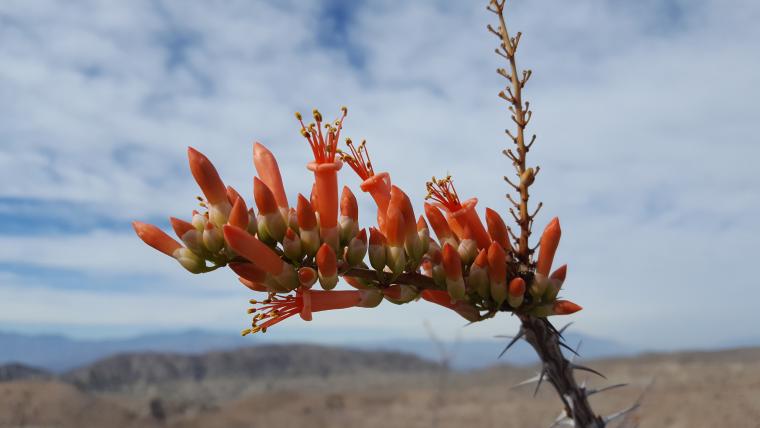
While they have only been phenologists for five years, phenology has been integrated into all aspects of their lives. As Rita says, phenology has given them experiences “you just never dreamed of.” When speaking of her favorite plant, Rita’s entire face lit up. She straightened in her seat, smiling wistfully as if she was imagining the plant in her living room. The ocotillo, native to Arizona, initially appears to be a bundle of sticks planted in the ground. But during springtime, the plant blooms into “spears of brilliant crimson flowers” with green leaves sprouting from thick stalks. For Steve, his favorite is the desert willow, another native tree bearing lavender and pink flowers. As Rita and Steve take their daily walks, they now find themselves pointing out the various flora around the neighborhood, admiring the different phenophases of each species. Often, their favorite stories to tell friends are ones about the surprising plant observations they made that week. What started as an interest has gradually grown into a lifestyle for Rita and Steve and an integral part of who they are.

Timing has influenced their lives, both in how they developed their relationship and with phenology. And as they continue to work as phenologists, Rita and Steve acknowledge the importance of time and patience in making observations.
It was amazing to learn that their favorite plant observations were those that took the most time. One plant that particularly tested their patience was the four-wing saltbush: a medium-sized bush decorated with leaves, small flowers, and fruit. Its fruit would shift from a pale green to a buttery yellow, but the plant’s flowers and fruit were frustratingly similar in size and color. As Rita says, it was difficult not just in counting the number of flowers that had grown, but merely in differentiating between flowers and fruit. Their group often met this challenge, and multiple (friendly) disputes arose as each volunteer bore a conflicting conclusion about the plant’s phenophases. However, given Rita’s career background of working with people, she became a mediator and was even deemed “very diplomatic” by a volunteer. However, Rita enjoys the collaboration, choosing to stay with the group not just for observations, but also to spend time catching up and hearing about their lives.

Steve had a similar experience through observing beargrass. Initially, the plant appears as a cluster of long, grass-like leaves about 2 feet high. Steve began observing the plant out of curiosity, as the beargrass appeared banal and “sort of sat there.” Days of observation resulted in no change in results. Time grew the days into weeks, and weeks into months. Week after week, Steve was met with a statue of a plant that truly tested his patience. But one morning, Steve dutifully went out to the trail to record data and noticed the plant had grown a stalk with large, lush, white colored flowers. In the span of a week, the beargrass changed entirely in appearance, its blossoming a symbol of the cathartic release Steve felt from seeing his efforts come to fruition. Even now, Steve reminisces about that moment as a “pretty spectacular” day.

Rita and Steve found that the plant observations that have taken the longest to observe are their most memorable. Like how they discovered phenology, this reflects how the most beautiful things in life are often the ones that take the most time.
Rita and Steve experience, time and time again, the power of patience and continue to do so by leading outreach events with local organizations. Nine members of the Master Gardeners Phenology Committee recently visited the Reid Park Zoo Monarch Conservation Program, especially interested in the zoo's pollinator garden. They applied their knowledge to a meeting outside their usual trails. A relationship has begun to form between the two groups, and Reid Park Zoo staff will soon be visiting the Master Gardener Demonstration Gardens.
Additionally, Steve and Rita put on a teaching workshop with another Master Gardener program, SAGE: Southern Arizona Gardening and Education Committee. Members of the community attend the workshop presentations. Rita and Steve, with some members of their committee, provided an educational presentation on phenology. The people attending also received tours of the gardens to learn how to observe phenology events.

Ultimately, Rita and Steve highlight how sometimes the best results can only form through time and patience. In a world where hustle culture and fast-tracking to success are increasingly popularized, hearing how they came to phenology was refreshing. From the words of Robert Frost, Rita and Steve are people “who lived in turning to fresh tasks,” ever willing to broaden their learning as community scientists. As if they weren’t busy enough, Rita is currently developing an online guide to providing group therapy to children. She plans to make this guide free and accessible to all who might need it. In their spare time, both Rita and Steve are active readers and enjoy spending time with a 14-year-old terrier poodle mix, Murphy.
Learn about author Jennifer Yang:

Jennifer Yang is a third year UCLA student majoring in Physiological Science and minoring in Biomedical Research.