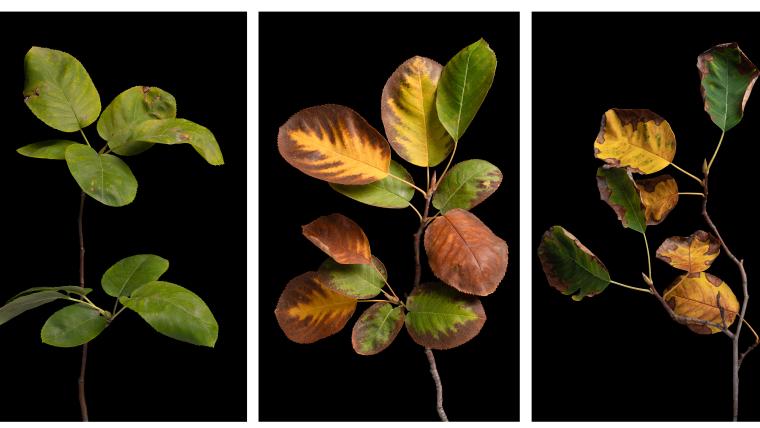
In this Observer Story written by UCLA student Amanda Lyons, we learn about Nature's Notebook observer Chris Peters. Chris is a photographer and observer with The Bloomingdale Trail in Chicago. This story was part of UCLA Faculty Dana Cairns Watson's course "Science Writing for Public Engagement and Community Science Projects." Students interviewed a Nature's Notebook observer and then wrote a creative piece to tell the observer's story.

“We’re always in nature, it’s not something you just go to,” states Chris Peters, observer and photographer. Chris has found that nature can be found even in the most urban environments, especially in Chicago, where he resides. I can sense his enthusiasm as he describes his goal of helping others discover and integrate nature into their daily lives.
Chris is a creator and has worked as a photographer for over 25 years. His passion for photography is what first led him to Nature’s Notebook around six years ago. During the COVID-19 quarantine, he began spending more time socializing through outdoor activities such as birdwatching.
A trail that Chris explored during this time was the Bloomingdale Trail, which is a part of The 606, a two point seven-mile-long abandoned rail line in Chicago that was transformed into a trail and park. Chris himself has lived in Chicago for the past 30 years and says that the trail is greatly beneficial to the community - “Something that makes it special is how integrated it is to the neighborhoods it goes through. It runs by like six elementary schools, connects to a major rail line, probably to like a dozen bus routes, and they allow biking on it. So it's not just a park.” Chris does not own a car, but can still easily get around the city, partially due to the walking and biking pathways that run along the 606.

The 606 was not always the natural space that it is today. The space was first developed into a railroad after the Great Chicago Fire in 1871 to help the city rebuild itself and to transport goods from the manufacturing district in northwest Chicago to the Chicago River. The Chicago River, which runs through the center of the city, carried goods to Lake Michigan before its 1900 reversal and then to the southwest after, making it essential in connecting Chicago’s industries to the rest of the country. The railway was a hub of manufacturing for almost a century, but eventually its activity slowed until it was abandoned altogether in the mid-1990s. During this time, the previous manufacturing district was converted into residential neighborhoods for underserved communities such as Wicker Park, Bucktown, Humboldt Park, and Logan Square. Residents from these communities explored the rail line as plants and animals reclaimed the space. Eventually, in 2003, legislation was created to designate the area as a public space, and The 606 was developed into the park the residents are familiar with today.
At this trail, Chris initiated a photography project that consisted of repetitively taking photos of the same plants to highlight their changes over time. Chris posted these and similar photos on his website to serve as educational material on phenology. He donates his time and photography skills to highlight the connection between beauty and nature. He intended to help others observe changes in nature and decided to research whether there were any other initiatives with a similar goal. What Chris discovered was Nature’s Notebook, a project through the USA National Phenology Network, that records changes in the phenology of plant activity. He joined The Friends of the Bloomingdale Trail, the trail’s observers who record the phenophases of primarily serviceberry plants for Nature’s Notebook.

A serviceberry is a native shrub found from the East Coast to the Rockies that produces round purple/red berries, Chris describes these as “slightly less sweet blueberries”. The serviceberry, known as Bozakmin by the Potawomi people, has been an important berry throughout history in the Great Lakes region. Potawatomi author Robin Wall Kimmerer explains the impact of the Serviceberry in Emergence Magazine, stating that they are gifts which should be treated with gratitude and reciprocity. Chris also values the service berry and shares that “the best day of observing is always the day that I can eat the service berries, the first day that I can eat them.” Chris hopes that more people can incorporate serviceberries into their cooking, which inspired him to contribute to the Berries for Bloomingdale: A Serviceberry Berry Cookbook, a cookbook pioneered by the phenology observer coordinator for Friends of the Bloomingdale Trail, Bonnie Tawse. Chris recalled some of his favorite recipes with the fruit - “I did one with serviceberries and thyme. That with some chili peppers on lamb was pretty good.” His recipes were making me crave serviceberries, which is impressive considering I have never tried one.

Observing for Nature’s Notebook has also made Chris more aware of the ramifications of climate change around him. He hopes that other people will be able to see those changes as well, sharing that, “the phenology project is perfect because it not only makes people more aware of climate change, but when people see the short-term changes around them, they can understand the larger, longer-term changes that happen.” Chris encourages people to learn about climate change by getting outside and observing the world around them.
For new observers, Chris recommends talking to observers who have already completed a full season of observations to get clarification on what signs to look for during each season. More generally, Chris urges everyone to put aside some time at least once or twice a week to take a look at the nature around them. His passion for nature is infectious, and I believe that his work is inspiring.
Chris shared that becoming a Nature’s Notebook observer has benefitted him personally. He has experienced periods of his life where he couldn’t escape the cycle of spending all day either working or at home. Chris remembers, “I would wake up, drive to work, get to the parking lot, walk from the parking lot to the building, work, walk back to the parking lot, drive back home, and like that was my entire life.” I can sense Chris’s relief that he broke out of this repetitive lifestyle. He believes in the importance of immersing oneself in nature and states that “it is anxiety building for me to not have some time every single day, just even half an hour walking around outside.”

Learn about author Amanda Lyons:

Hi, my name is Amanda Lyons and I am a second year at UCLA. I am a Molecular Biology (MCDB) major and enjoy volunteering, dancing, and spending time outside! This quarter, I am taking Science Writing for Public Engagement and Community Science Projects where we learn how to write about nature and all those who interact with it. I had a pleasure working with Chris Peters to highlight his important observational work through this article!
This piece was submitted on June 2, 2026.